Hematoma location as an effect modifier of surgical evacuation in spontaneous ICH
Surgery for intracerebral haemorrhage has never shown a clean overall benefit. This review asks a narrower question: does it matter where the bleed is — deep versus lobar — and is the difference big enough to act on?
Why it matters
ICH is the deadliest subtype of stroke, and the two largest craniotomy trials — STICH and STICH-2 — found no clear overall functional benefit. A post-hoc signal in STICH suggested superficial lobar bleeds might do better with surgery; that single observation shaped the design of STICH-2.
The minimally invasive generation has revived the question without settling it. ENRICH showed benefit concentrated in lobar haemorrhage; MISTIE III and MIND 2025 found no overall benefit. Deep and lobar bleeds have different pathology — hypertensive small-vessel disease versus cerebral amyloid angiopathy — so a location effect is biologically plausible.
The most recent meta-analysis in this space excluded conventional craniotomy trials, leaving out STICH-2 — the only randomised trial with a purely lobar population — and reported no formal test for subgroup interaction. This review pools both surgical generations and tests the interaction directly.
Results as submitted
Submitted — under peer reviewThese are the figures from the submitted manuscript. It hasn't completed peer review yet, so numbers may still change — please wait for the published version before citing them.
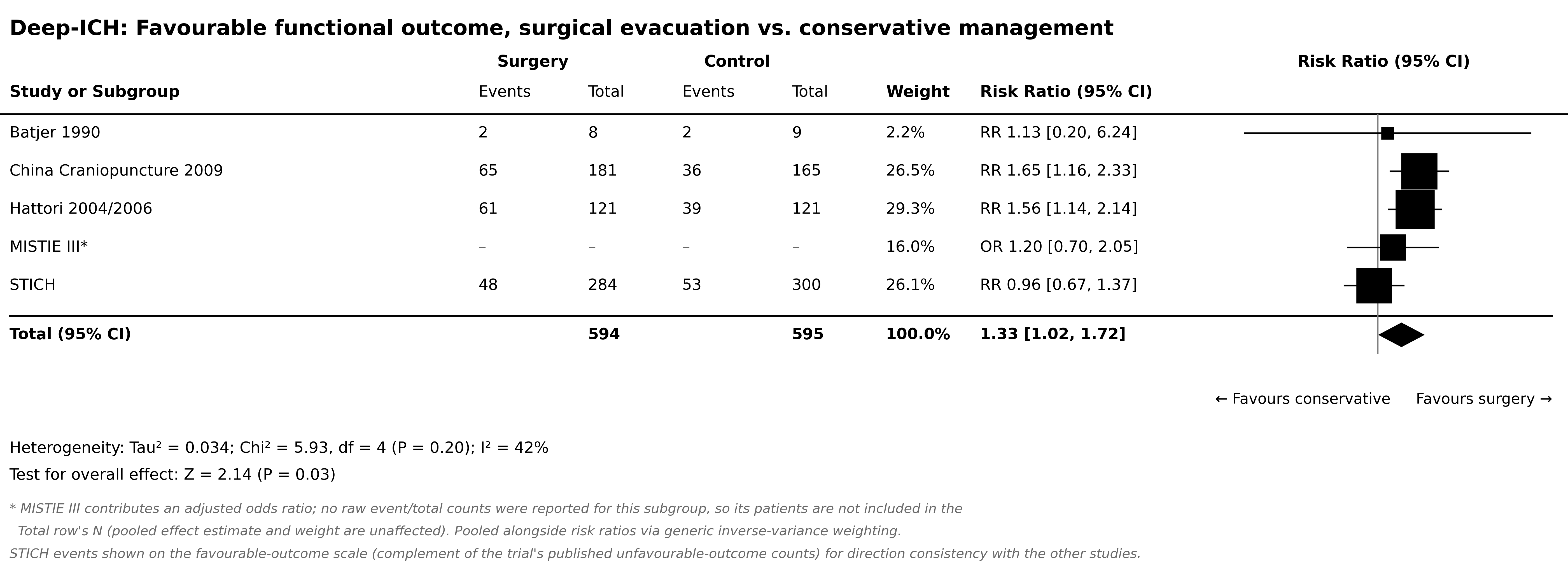
In deep haemorrhage, evacuation is associated with a higher rate of favourable functional outcome.
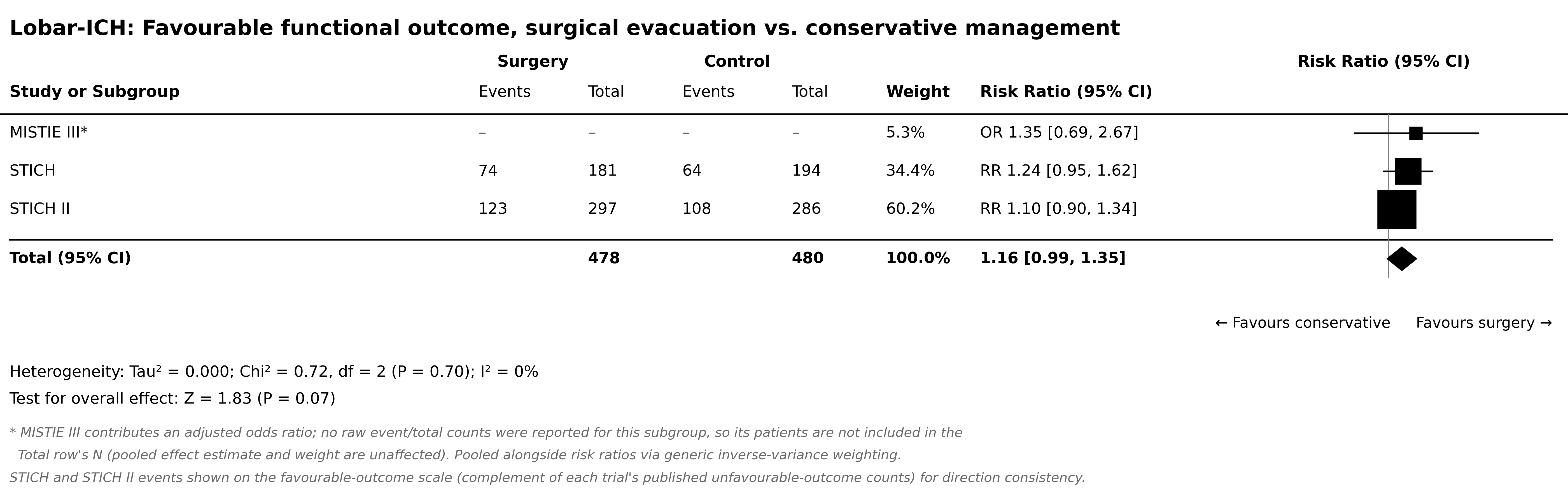
In lobar haemorrhage the direction is the same but the interval crosses one — consistent with benefit, not yet demonstrating it.
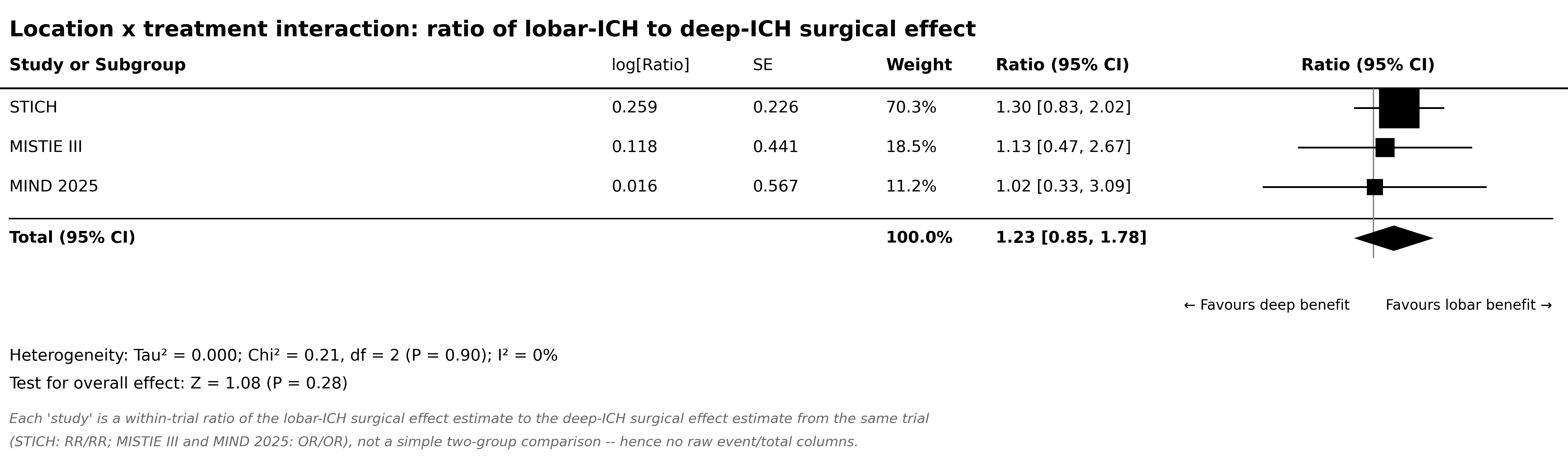
The formal test — within-trial ratios only, so randomisation is preserved — does not show that location modifies the surgical effect. The subgroup contrast people have been reading into this literature does not survive it.